
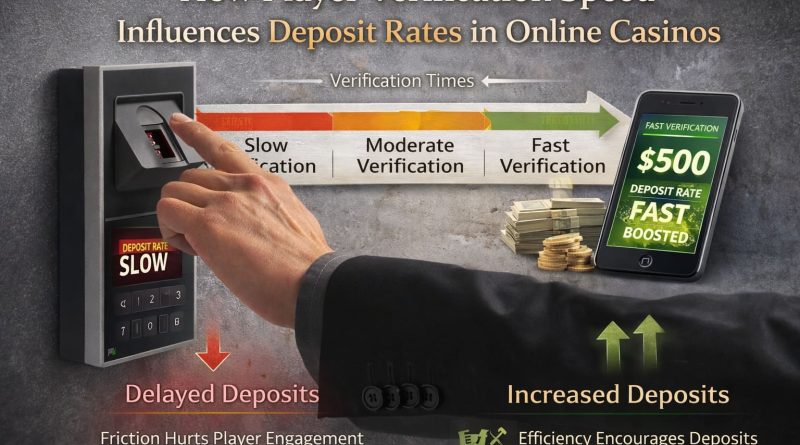
How Player Verification Speed Influences Deposit Rates in Online Casinos
A player registers, clicks around the lobby, and finally decides to top up their wallet with fifty dollars. They enter card details, hit “Deposit,” and expect that quick “Success” screen. Instead, they get a hard stop: “Please verify your identity before proceeding.” No warning, no context, no timeline. The player exhales, closes the tab, and tells themselves they’ll deal with it later. By the next morning, the impulse is gone—and so is the deposit.
This isn’t a rare edge case. It happens every day, at scale. Verification exists for good reasons: stopping underage play, meeting AML requirements, reducing fraud, and protecting accounts. But the same controls that keep a platform safe can also quietly kill conversion when they appear at the wrong time or take too long to resolve. For operators, the goal isn’t “skip KYC.” It’s “don’t turn KYC into a speed bump that becomes a dead end.”
Different brands handle the trade-off differently. Some force full identity checks at signup, others allow an initial deposit, and some use staged verification based on risk or thresholds. Players notice the differences immediately. One site feels smooth. Another feels like a bureaucratic checkpoint. Platforms like pokies114 have tested multiple timing models to reduce abandonment while staying within compliance expectations. And in practice, the outcome depends less on the policy itself and more on how the flow is designed, explained, and executed.
To understand how verification speed changes deposit conversion, you have to zoom out. It’s not only “minutes to approve.” It’s player psychology, UX clarity, automation quality, review capacity, document rejection rates, and the gap between what marketing promises and what onboarding actually does. Let’s break down where deposits get lost—and how to stop that loss without weakening safety.
Why Verification Speed Matters More Than Most Teams Admit
Deposits live inside a very small “motivation window.” In that moment, intent is high and friction tolerance is low. Add two extra steps, one confusing instruction, or a vague “we’ll review your documents soon,” and the window collapses. It’s the same reason e-commerce fights checkout friction—but gambling is more emotionally sensitive: the player isn’t just buying something, they’re committing to a money-and-trust action.

Slow or unclear verification doesn’t just delay the deposit; it plants doubt. If it’s hard to deposit, will it be worse to withdraw? If the site can’t explain a simple process, can it be trusted with funds? That suspicion forms quickly, especially before a player has any loyalty, wins, or positive support experience to balance the feeling.
Speed helps, but clarity often helps more. A ten-minute check with no feedback can feel slower than a thirty-minute check that shows a status bar, gives a realistic ETA, and confirms the upload worked. Players don’t mind “necessary.” They mind “mysterious.”
This is why verification delays are so costly early in the relationship. At the first-deposit stage, players haven’t invested enough to push through frustration. A long-time customer might wait; a newcomer just leaves. And that’s how compliance becomes a conversion problem.
Where Verification Sits in the Funnel (and Why Timing Changes Everything)
Operators typically choose one of four timing models: verify before deposit, after deposit, staged by thresholds, or risk-based/adaptive. Each one shifts conversion and risk in different directions. Pre-deposit verification gives maximum certainty and prevents “surprise checks” later, but it introduces friction at the exact moment players are ready to deposit. Post-deposit verification can capture more initial deposits, but it increases fraud exposure and can create painful withdrawal moments if a player wins before they’re cleared. Many jurisdictions also restrict how far you can push “play first, verify later.”
Staged verification is the middle ground: ask for the minimum upfront and escalate only when a player crosses specific triggers (bigger deposits, payout requests, unusual patterns). Risk-based verification takes that idea further by tailoring checks to each player’s risk profile—fast, mostly invisible onboarding for low-risk segments; deeper review for outliers.
| Verification timing | Player perception | Deposit impact | Compliance trade-off |
|---|---|---|---|
| Pre-deposit (full KYC) | Secure but “heavy” | Higher abandonment; strongest intent segment survives | Maximum certainty; fewer post-deposit surprises |
| Post-deposit (delayed KYC) | Fast and friendly | Higher initial conversion; potential withdrawal friction | Higher fraud exposure; not permitted everywhere |
| Staged (threshold-based) | Fair and proportional | Captures small deposits; escalates when needed | More complexity; needs good monitoring |
| Risk-based (adaptive) | Invisible for low-risk players | Best overall balance when executed well | Requires data, tooling, and strong review ops |
What Actually Slows KYC Down (The Non-Obvious Bottlenecks)
Teams often blame “regulation” for slow verification, but the worst delays are usually operational: bad document guidance, avoidable rejections, and understaffed manual queues. The most common cause is still basic: players upload blurry photos, cropped images, glare-covered IDs, or the wrong document type. If automation can’t confidently parse what’s submitted, everything falls into manual review—and that’s where timelines explode.

Name and address mismatches are another quiet killer. Players register with nicknames, shortened names, or an old address, then submit official documents that don’t match. Even innocent inconsistencies can trigger escalations and back-and-forth emails. And every extra cycle (“please resubmit”) is another chance for the player to abandon.
Third-party verification tools can also introduce latency. One slow database check, one unavailable endpoint, or one provider-side queue can stall the whole flow. Then you have the human factor: if manual reviewers work business hours in one time zone, documents uploaded “right now” may not be touched for 8–12 hours. For a first-time depositor, that delay often equals churn.
- Photos with glare, shadows, or motion blur that hides text
- Cropped documents where corners or key fields aren’t visible
- Expired IDs or documents that are outside the accepted date window
- Wrong proof-of-address type (or bills older than the allowed threshold)
- Screenshots/photocopies when originals are required
- Mismatch between registration details and document details (name, address, country)
- Unsupported formats (e.g., HEIC uploads on systems expecting JPG/PNG/PDF)
- Multi-page documents merged into one confusing file without clear labeling
- Documents in languages the review team can’t reliably assess without extra steps
- Players submitting one item at a time, triggering multiple review cycles
The Psychology of Friction: When “Safety” Feels Like Rejection
Verification isn’t emotionally neutral for players. It can feel like suspicion, even when it’s routine. If the request appears suddenly—especially during a deposit attempt—many players interpret it as “we don’t trust you,” not “we’re protecting your account.” That emotional framing matters, because it changes whether they cooperate or walk away.
Unclear instructions make it worse. “Upload proof of identity” sounds simple until a player wonders: passport or driver’s licence? Front only or front and back? Photo or scan? How recent does proof of address need to be? Every unanswered question increases the chance of a wrong submission, a rejection, and another delay.
The tone you use also changes completion rates. Legalistic copy (“pursuant to regulatory obligations…”) creates distance. Plain language (“We verify accounts to keep your funds secure and meet licensing rules”) builds cooperation. Players don’t need a law lecture; they need a clear reason and a clear path.
Finally, silence is friction. If a player uploads documents and hears nothing, they assume the worst. A simple “Documents received—reviewing now” message prevents a lot of churn and a lot of support tickets.
UX Patterns That Increase Deposit Completion Without Weakening Compliance
The biggest wins usually come from basic UX hygiene: progressive disclosure, strong examples, immediate feedback, and predictable timelines. Instead of dumping a list of requirements on a player, guide them step-by-step: ID first, then address, then payment method if needed. The flow feels doable, not overwhelming.
Explain the “why” in one sentence. “We verify accounts to prevent fraud and protect your withdrawals” works better than “verification is mandatory.” Then give players what they need to succeed: visual examples of acceptable documents, simple photo tips, and clear file requirements.
Real-time image validation is especially powerful. If the system detects blur or missing edges, reject the upload immediately with specific guidance instead of letting it fail later in a manual queue. That one change can cut verification time by hours for a meaningful chunk of users.
| Friction point | What players do | Better UX pattern | Why it works |
|---|---|---|---|
| Unclear requirements | Submit the wrong docs repeatedly | Annotated examples + “accepted list” per country | Removes guesswork; reduces resubmissions |
| Poor photo quality | Upload blurry/cropped images | Real-time validation with specific fixes | Catches issues before review queues |
| No status visibility | Wait anxiously or spam support | Progress states + auto updates | Reduces uncertainty and churn |
| Too much upfront | Abandon before starting | Guided one-step flow | Lowers cognitive load; boosts completion |
| Legalistic tone | Feel accused or suspicious | Friendly, protective framing | Builds trust and cooperation |
Fast KYC vs Safe KYC: The Risk-Based Approach (Plain English)
Not every player carries the same risk. Someone depositing $20 for casual play doesn’t look like someone depositing $2,000 within an hour, using a VPN, and cycling funds quickly. Risk-based verification means you don’t treat every player like the highest-risk case—because doing so burns conversion and overwhelms review teams. Instead, you apply proportional checks based on signals.
Signals can include geography, device and behavioral patterns, payment history, velocity of transactions, and third-party data matches. Low-risk players can often clear quickly through automated checks. Medium-risk players may need one document. High-risk players may need full KYC plus source-of-funds checks. Done correctly, this approach improves both conversion and safety: you reduce friction where it isn’t needed and concentrate scrutiny where it matters.
The catch is operational maturity. Risk-based systems need solid data, reliable vendors, clear rules for escalation, and trained reviewers. But when it’s implemented well, it’s one of the few strategies that improves deposit conversion without creating compliance headaches later.
Operator Metrics That Connect Verification to Deposits
If you want to prove the relationship between verification speed and deposit rate, track the right points in the journey. Start with the gap between deposit initiated and deposit completed. Then map drop-off inside verification: do players quit at upload, after upload, or while waiting for review? Each pattern points to a different fix (UX clarity vs processing speed vs communication).
Time-to-verify should be measured in segments: automated vs manual, and by risk category. The average can hide the real problem. If automated approvals take 3 minutes but manual reviews take 18 hours, “average 2 hours” doesn’t tell you why newcomers are leaving.
- Deposit start rate vs deposit complete rate (first session and first 24 hours)
- Verification abandonment rate by step (ID upload, address upload, waiting stage)
- Document rejection rate (and top rejection reasons)
- Time-to-verify split by automated vs manual
- Manual queue wait time by hour/day (capacity planning signal)
- Support contacts tagged “verification” (volume + repeat contacts)
- Fraud/chargeback rate by verification path (safety check against “speed hacks”)
- Player LTV by verification experience (smooth onboarding often correlates with higher value)
- Return rate after abandonment (do they come back, or are they gone for good?)
Player Education That Helps Conversion (Without Sounding Like a Threat)
Small language changes can move real numbers. Replace vague, cold messages with specific, calm expectations. “We’re verifying your details (usually under 2 hours)” beats “Your account is under review.” Add practical tips right where players need them: “Show all four corners,” “Avoid glare,” “Accepted formats: JPG/PNG/PDF.” When players succeed on the first attempt, speed increases automatically.
Education also works best when it’s proactive. A tiny “Why we ask” tooltip, a short example image, or a one-minute “how to take a good ID photo” guide can prevent most of the errors that create multi-day verification loops. The goal is not to dump information—it’s to remove the most common reasons players fail.
- “We verify accounts to keep your funds secure and prevent fraud.”
- “Most checks finish in 2–5 minutes; some take up to 24 hours.”
- “Make sure your full name and address are visible.”
- “Avoid glare and shadows—use bright, even lighting.”
- “Show all four corners of the document.”
- “Accepted formats: JPG, PNG, PDF (max 5MB).”
- “We’ll email you the moment you’re approved.”
- “Need help? Live chat is available 24/7.”
- “Your documents are stored securely and used only for verification.”
A Practical “Fast Verification” Playbook (30–60 Days)
You don’t need a full rebuild to improve verification speed and recover lost deposits. In 30–60 days, most teams can move the needle by focusing on the highest-impact basics: audit the flow, reduce avoidable rejections, and shorten the “silent waiting” period with better status updates.
Start with a real journey audit. Go through the flow as a first-time player on desktop and mobile. Time each step. Note where instructions are unclear. Pull a sample of rejected documents and categorize why they failed. Then fix the top three causes first—because those are the ones clogging your queues and exhausting player patience.
Status communication is a cheap win. A “received → reviewing → approved” tracker and automated updates remove uncertainty immediately. And if you run manual reviews, you need coverage strategy: even a small after-hours review window can save a huge chunk of first-deposit conversions.
Many operators improving onboarding flows around the pokies net login experience (and similar entry points) see the same pattern: when you reduce rejections and add predictable updates, deposits recover even if the underlying compliance checks stay just as strict.
| Action | Effort | Expected impact | Notes |
|---|---|---|---|
| Audit the current verification flow | Low (2–3 days) | Finds the real drop-off points | Do it on mobile + desktop; test multiple doc types |
| Create annotated document examples | Low (3–5 days) | Fewer wrong uploads; faster approvals | Show good vs bad with simple callouts |
| Rewrite microcopy in plain language | Low (2–4 days) | Higher completion; less suspicion | Focus on “why,” “what,” and “how long” |
| Add real-time upload validation | Medium (1–2 weeks) | Lower rejection rates | Blur detection + corner/edge checks if possible |
| Implement automated status updates | Medium (1–2 weeks) | Less churn; fewer support tickets | Short, consistent updates at key milestones |
| Train support on verification triage | Low (1–2 days) | Faster fixes for edge cases | Give agents clear “what we can approve” rules |
| Analyze and fix top rejection causes | Medium (2–3 weeks) | Biggest long-term speed gain | Data-driven; don’t guess |
Conclusion
Verification speed influences deposit rates, but the bigger story is the experience around that speed. Players can tolerate checks when the process is clear, fair, and predictable. They abandon when it feels random, accusatory, or silent. The best-performing operators treat verification as part of onboarding—not as a compliance wall dropped in front of a deposit button.
The strongest approach is usually proportional: frictionless for low-risk players, thorough for high-risk cases, and transparent for everyone. If operators invest in clarity, guidance, and queue management, verification stops being a conversion killer and starts becoming what it should be: a moment that builds confidence instead of draining it.
Done well, verification doesn’t feel like a barrier—it feels like the platform is taking security seriously.